Invasive Aedes aegypti mosquito found in Redwood City
Versión en español a continuación
FOR IMMEDIATE RELEASE
Contact: Rachel Curtis-Robles, PhD
Communications Director
650-344-8592
Invasive Aedes aegypti mosquito found in Redwood City
Burlingame, CA (July 27, 2026) - The San Mateo County Mosquito and Vector Control District has recently detected invasive Aedes aegypti mosquitoes in the Friendly Acres neighborhood of Redwood City. The District is checking properties in the area to determine how widespread the Aedes aegypti mosquitoes are in the area.
Aedes aegypti are small (about ¼ inch) black and white mosquitoes that bite aggressively during the day. They are an invasive species not native to California, but they have become established throughout the United States, including in many California counties. Aedes aegypti mosquitoes can potentially spread several diseases, including dengue, chikungunya, Zika, and yellow fever. At this time, the risk of Aedes aegypti spreading disease in San Mateo County is very low.
“We need the public’s help to stop this mosquito. Our staff are working hard to prevent the mosquito from spreading. Our goal is to control and eliminate invasive Aedes aegypti mosquitoes from San Mateo County,” said District Manager Brian Weber.
District staff will be doing door-to-door property visits in the Friendly Acres neighborhood and nearby areas to find standing water where mosquitoes can grow. District staff will set extra mosquito traps to find invasive Aedes aegypti mosquitoes.
Resident involvement is critical to help protect the neighborhood from the Aedes aegypti mosquitoes. The mosquitoes lay their eggs in small containers such as saucers under potted plants, bird baths, fountains, toys, old tires, yard drains, and small puddles in many outdoor containers.
“Dumping standing water is one of the most effective ways to prevent mosquitoes from breeding around your home,” said Rachel Curtis-Robles, communications director for the District. “Even small amounts of water – as small as a bottle cap full of water – can produce mosquitoes. It’s important to check around your home and dump water at least once a week to prevent mosquitoes.”
Residents can protect themselves from mosquito bites by doing the following:
- Dump all standing water at least once a week, including water in vases, flowerpots and saucers, old tires, buckets, pet water dishes, bird baths, and trash cans. Mosquitoes can lay their eggs in very small amounts of standing water.
- When outside and mosquitoes are active, apply insect repellent containing an active ingredient registered with the Environmental Protection Agency – such as DEET, picaridin, oil of lemon eucalyptus, or IR3535 – according to label instructions.
- Wear long sleeve shirts, long pants, socks, and shoes when mosquitoes are most active.
- Be sure window and door screens are in good condition to prevent mosquitoes from entering your home.
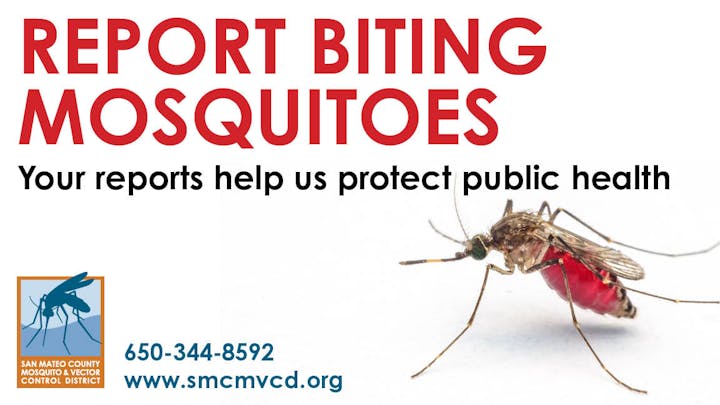
- Report biting mosquitoes to the District at 650-344-8592 or online at https://www.smcmvcd.org/.
County residents may recall that the Aedes aegypti mosquito was found in Menlo Park from 2013-2015 but was successfully eradicated. The eradication was successful because residents collaborated with the District’s efforts. “The previous success was only possible because the public did their part in dumping standing water, reporting biting mosquitoes, and letting us check their properties for standing water. Again, we need the help and cooperation of residents of the area to find and eliminate this mosquito,” said Operations Director Casey Stevenson.
For more information about invasive Aedes aegypti and District services, call 650-344-8592 or visit www.smcmvcd.org. The San Mateo County Mosquito and Vector Control District’s programs and services are funded through property taxes and benefit assessments and are provided to all residents in San Mateo County at no additional charge.
###
About the San Mateo County Mosquito & Vector Control District: We are an independent special government district focused on protecting the public health of the residents of San Mateo County through a science-based program of integrated vector management that is responsive to the community. The District delivers specific services to residents and businesses under the guidance of a Board of Trustees comprising representatives from each of the 20 cities in San Mateo County and the County Board of Supervisors.
Versión en español
PARA DIFUSIÓN INMEDIATA
Contacto: Rachel Curtis-Robles, PhD
Directora de Comunicaciones
650-344-8592
Se detecta el zancudo invasor Aedes aegypti en Redwood City
Burlingame, CA (27 de julio de 2026) - El Distrito de Control de Mosquitos y Vectores del Condado de San Mateo ha detectado zancudos Aedes aegypti recientemente en el vecindario de Friendly Acres de Redwood City. El Distrito está inspeccionando propiedades en la zona para determinar qué tan extendida está la presencia de zancudos Aedes aegypti en la área.
Los Aedes aegypti son zancudos pequeños (de aproximadamente 6 mm), de color blanco y negro, que pican agresivamente durante el día. Son una especie invasora que no es originaria de California, pero se han establecido en varias partes de Estados Unidos, incluyendo muchos condados de California. Los zancudos Aedes aegypti pueden transmitir varias enfermedades, como el dengue, la chikungunya, el Zika y la fiebre amarilla. Actualmente, el riesgo de que el Aedes aegypti propague enfermedades en el condado de San Mateo es muy bajo.
“Necesitamos la ayuda de la comunidad para detener este zancudo. Nuestro personal está trabajando arduamente para prevenir la propagación de este zancudo. Nuestro objetivo es controlar y eliminar los zancudos Aedes aegypti invasores del condado de San Mateo,” declaró el Gerente del Distrito Brian Weber.
El personal del Distrito realizará visitas puerta a puerta en el vecindario de Friendly Acres y áreas cercanas para detectar agua estancada donde puedan crecer los zancudos. También el personal colocará trampas adicionales para zancudos con el fin de encontrar zancudos Aedes aegypti invasores.
La participación de los residentes es fundamental para proteger el vecindario de los zancudos Aedes aegypti. Los zancudos depositan sus huevos en pequeños recipientes como platillos debajo de macetas, bebederos para pájaros, fuentes, juguetes, neumáticos viejos, desagües de jardín y pequeños charcos en muchos recipientes exteriores.
“Eliminar el agua estancada es una de las maneras más efectivas de prevenir la reproducción de zancudos alrededor de su hogar”, dijo Rachel Curtis-Robles, directora de comunicaciones del Distrito. “Incluso pequeñas cantidades de agua, como la que cabe en una tapa de botella, pueden generar zancudos. Es importante revisar su casa y vaciar el agua estancada al menos una vez por semana para prevenir los zancudos”.
Los residentes pueden protegerse de las picaduras de zancudos siguiendo estas recomendaciones:
- Vaciar toda el agua estancada al menos una vez por semana, incluyendo el agua de floreros, macetas y platillos, neumáticos viejos, cubos, bebederos para mascotas, bebederos para pájaros y botes de basura. Los zancudos pueden depositar sus huevos incluso en cantidades muy pequeñas de agua estancada.
- Cuando esté al aire libre y haya zancudos activos, aplique repelente de insectos que contenga un ingrediente activo registrado ante la Agencia de Protección Ambiental (EPA), como DEET, picaridina, aceite de eucalipto limón o IR3535, siguiendo las instrucciones de la etiqueta.
- Use camisas de manga larga, pantalones largos, calcetines y zapatos cuando los zancudos estén más activos.
- Asegúrese de que los mosquiteros de ventanas y puertas estén en buen estado para evitar que los zancudos entren en su casa.
- Reporte las picaduras de zancudos al Distrito llamando al 650-344-8592 o en línea en https://www.smcmvcd.org/.
Los residentes del condado podrán recordar que el zancudo Aedes aegypti se detectó en Menlo Park entre 2013 y 2015, pero fue erradicado con éxito. La erradicación fue posible gracias a la colaboración de los residentes con los esfuerzos del Distrito. “El éxito anterior solo fue posible gracias a la colaboración de la comunidad, que se encargó de eliminar el agua estancada, reportar la presencia de zancudos picadores y permitirnos revisar sus propiedades en busca de agua estancada. Nuevamente, necesitamos la ayuda y cooperación de los residentes de la zona para encontrar y eliminar este zancudo”, declaró el Director de Operaciones, Casey Stevenson.
Para obtener más información sobre el zancudo invasor Aedes aegypti y los servicios del Distrito, llame al 650-344-8592 o visite www.smcmvcd.org. Los programas y servicios del Distrito de Control de Mosquitos y Vectores del Condado de San Mateo se financian mediante impuestos a la propiedad y contribuciones especiales, y se ofrecen a todos los residentes del Condado de San Mateo sin costo adicional.
###
Acerca del Distrito de Control de Mosquitos y Vectores del Condado de San Mateo: Somos un distrito gubernamental especial independiente enfocado en proteger la salud pública de los residentes del Condado de San Mateo a través de un programa de manejo integrado de vectores basado en la ciencia y que responde a las necesidades de la comunidad. El Distrito presta servicios específicos a los residentes y a las empresas bajo la dirección de una Junta Directiva compuesta por representantes de cada una de las 20 ciudades del condado de San Mateo y de la Junta de Supervisores del Condado.